
Cloud billing management is the coordinated set of systems and processes that measure cloud resource consumption, convert usage into monetary units, apply pricing and tax rules, and produce invoices and reports. In practice, this concept covers metering of compute, storage and network resources; rating engines that map usage to pricing plans; mediation layers that normalize raw telemetry; and invoice generation that reflects taxation and regulatory requirements. For organisations operating in France, additional elements often include VAT (TVA) handling, French-language invoice presentation, and data-processing considerations under national and EU law.
Key modules in a cloud billing architecture typically include usage collection, rating and pricing engines, account balance management, invoice formatting and distribution, dispute handling, and analytics. These modules may integrate with accounting systems (logiciels de comptabilité), customer portals, and identity systems. In the French context, billing systems may need to support formats and content required by local authorities and comply with CNIL guidance for personal data processing when customer identifiers or usage traces are involved.
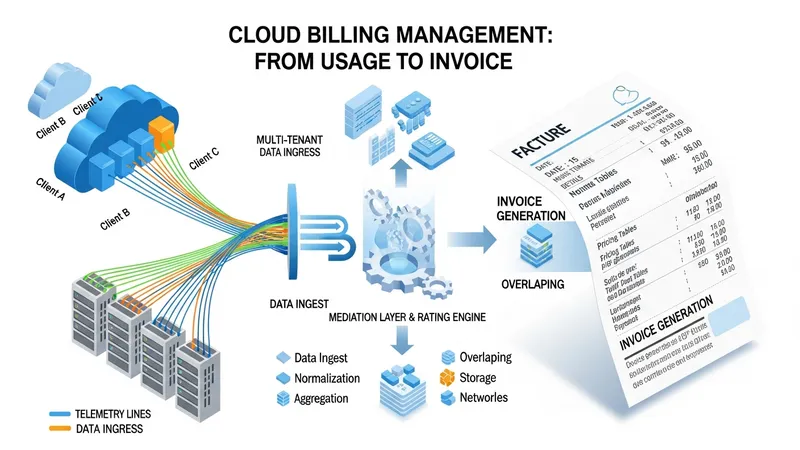
Comparing these example providers illustrates common billing elements: machine-hours or vCPU-hours, GB-month storage units, and GB network transfer units. A billing solution may aggregate these units into a single invoice and apply discounts, committed-use rates, or tiered pricing structures. In France, invoices typically must show VAT at the applicable rate and contain specific legal mentions; service-public.fr and related guidance outline mandatory invoice components that billing modules often produce automatically. These requirements influence invoice templates and calculation flows.
Rating engines and pricing models are central to translating metered usage into charges. Common approaches include pay-as-you-go metering, tiered volume pricing, and subscription or recurring charges for managed services. For multi-tenant environments, billing systems often include tenant-specific tariff tables and allocation rules so that consumption is billed to the correct legal entity. When operating in France, organisations often consider how TVA applies to cross-border services and whether domestic or intra-community rules affect invoice presentation.
Data collection and mediation layers typically handle raw telemetry from hypervisors, object stores, and network devices, converting diverse records into normalized usage records. Normalization may include time-based aggregation, rounding rules, and attribution to cost centers. In France, where data residency and protection are considerations for some sectors, architects may choose France-based storage or regional availability zones to align with organisational policies and CNIL recommendations. These choices can affect latency of reporting and storage costs that appear in billing.
Integrations with accounting and ERP systems are common in an operational billing workflow. Systems such as French bookkeeping software and ERP connectors may import invoice data, taxes, and journal entries exported by the billing platform. Reconciliation modules often compare expected revenue from rated usage to payments received, flagging discrepancies for investigation. For organisations subject to audit in France, maintaining a clear audit trail of rated usage, invoice versions, and tax calculations can support compliance checks.
Scaling a billing platform involves both technical and organisational considerations: the ability to process increasing volumes of usage records, to maintain low-latency rating for real-time billing scenarios, and to support high concurrency for customer portals. In France, seasonal demand patterns in certain industries (retail, media) may require capacity planning and testing to avoid billing delays. Monitoring and capacity planning tools may often be used to project processing needs and to schedule maintenance without affecting invoicing cycles.
In summary, cloud billing management covers metering, rating, invoicing, reporting, and integrations adapted to local regulatory and tax requirements. In the French context, VAT handling, invoice content, and data-protection considerations commonly influence system design and operational procedures. The next sections examine practical components and considerations in more detail.
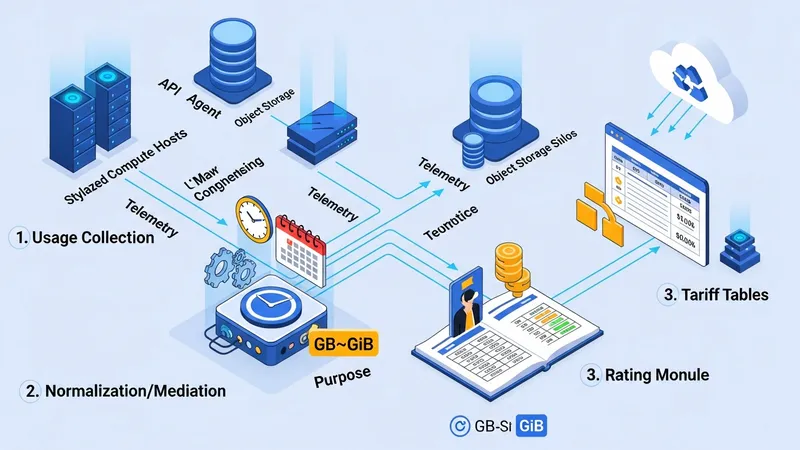
Billing modules generally break down into discrete functional categories: usage collection, normalization/mediation, rating, invoicing and distribution, payment reconciliation, and analytics. Each category addresses a specific step in converting raw cloud telemetry into financial records. In France, invoice content may need to include TVA details and legal mentions; therefore the invoicing module often contains templates localized for French customers. When selecting module capabilities, organisations typically assess whether the module supports API access, audit logging, and language localization relevant to France.
Usage collection in cloud billing often relies on agents, APIs, and telemetry exports from compute hosts, object storage, and network appliances. Normalization performs unit conversions and aligns timestamps to billing periods. For French deployments, data retention and access controls may be shaped by CNIL recommendations and organisational privacy policies. Operators often consider whether data must remain in France for regulatory reasons, which can affect choices about regional availability zones and storage class pricing that subsequently reflect on invoices.
The rating component maps normalized usage to monetary values using pricing rules that may include tiered thresholds, volume discounts, time-based rates, and subscription offsets. In a French corporate setting, VAT treatment is calculated after net charges and presented on invoices at the applicable French rate (standard rate typically around 20% for many services, though specific rates vary by product). Billing systems may implement rule engines that can express such conditional logic to ensure invoices reflect local tax outcomes.
Invoice distribution and customer portals enable customers to review usage, download PDF invoices, and access structured invoice data (e.g., XML or CSV). For organisations operating in France, invoice formats often include French-language labels and legal references; portals may offer exports compatible with French accounting systems. Analytics and reporting modules commonly provide summaries that finance teams in French firms use for forecasting and tax preparation, which may be exported to local accounting workflows.
Pricing models in cloud environments commonly include pay-per-use, reserved capacity, and subscription plans, each requiring different rating logic. Pay-per-use maps each normalized unit to a unit price and may include tiered thresholds where per-unit price decreases with volume. Reserved or committed models typically apply a fixed recurring charge and adjust per-use billing with offsets or credits. French providers and cloud operators often publish example price pages in euros that illustrate typical ranges for instance types, storage and bandwidth, and billing systems frequently import these published rates into their rating rules.
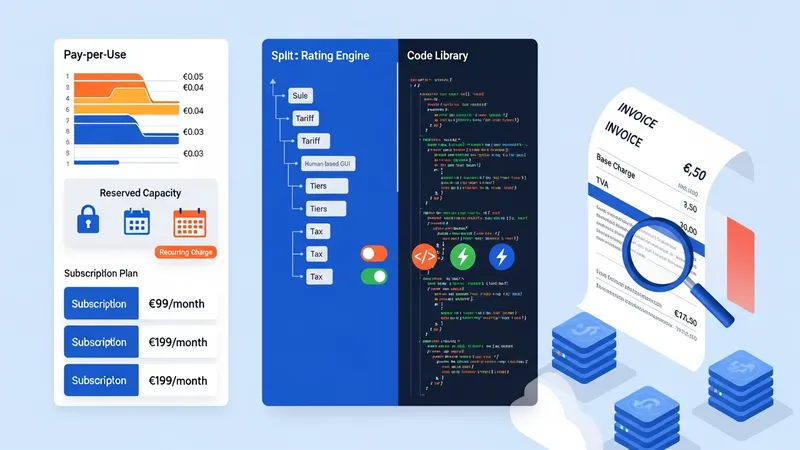
Rating engines can be implemented as rule-based systems or as code libraries invoked during billing runs. Rule-based engines allow business users to declare tariffs, tiers, and taxes in a structured format without code changes, while library-based implementations may offer tighter integration with real-time services. When operating in France, teams commonly ensure rating outputs include separate lines for base charge and TVA to align with French invoicing practice and to facilitate accounting reconciliation.
Testing rating logic is a critical operational step: synthetic usage scenarios are often generated to verify tier transitions, discount application, and tax calculation. In France, accounting and audit teams may request demonstration invoices that show the TVA calculation and legal invoice fields; therefore billing test suites often include cases specific to French tax treatment and invoice presentation. Careful versioning of rating rules helps preserve historical invoiceability and supports regulatory record-keeping.
Interfacing rating results with payment and collections systems completes the monetisation path. Billing systems typically export invoice lines and totals to accounting modules for journal entry creation. In France, payment terms and remittance methods commonly follow local commercial practice, and integrations may include SEPA remittance details. Teams often treat payment and collections as separate workflows but ensure reconciled results feed back into billing records for completeness and audit traceability.
Tax and invoice compliance influence several billing design decisions. French invoicing rules, as summarized on service-public.fr, specify certain invoice elements such as seller and buyer identification, invoice date, and TVA details when applicable. Billing platforms typically include template engines that populate these fields automatically. Organisations operating across EU borders may also need to account for intra-community VAT rules and apply reverse-charge mechanisms where appropriate, which billing logic must represent as conditional tax entries on invoices.
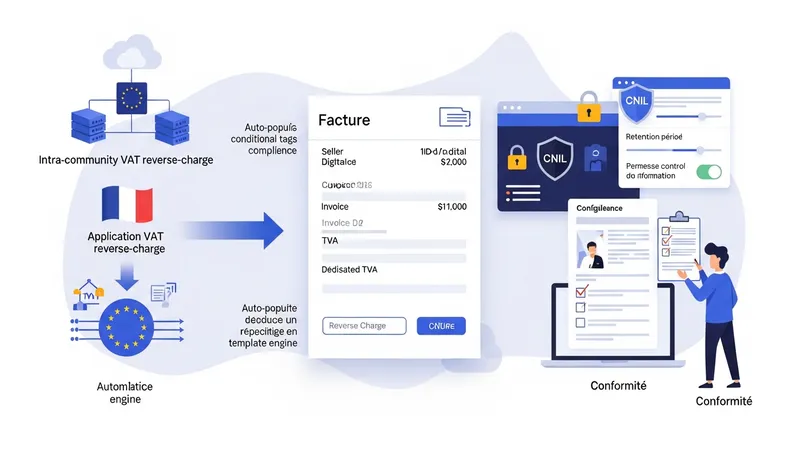
Data protection and localisation may affect how usage records are stored and processed. The CNIL (cnil.fr) provides guidance on personal data handling that can apply when usage records include personal identifiers or when invoices contain customer personal data. French organisations often document data flows and retention periods in order to demonstrate compliance; billing systems may offer configurable retention policies and access controls to meet such requirements.
Auditability is an important compliance dimension. Billing systems in France often retain historical versions of invoices, rating configurations, and raw usage records to support financial audits and tax inspections. Secure logging, non-repudiation of invoice issuance, and exportable audit trails are typical features that finance teams request. Maintaining a clear mapping between rated usage and produced invoices helps address questions in tax reviews or internal accounting validation.
Local statutory reporting and corporate accounting standards can shape invoice formats and export standards. Many French companies integrate billing outputs with local accounting software and follow chart of accounts conventions used in France. Providing structured exports (e.g., CSV or XML with localization) and aligning invoice numbering and dating policies to French commercial code practices are considerations that may simplify downstream accounting and fiscal reporting.
An operational billing workflow typically follows a cycle: collect usage, normalize records, apply rating, generate invoices, distribute invoices, and reconcile payments. For French organisations, each step may include localisation needs such as TVA calculation, French-language invoice text, and legal mention insertion. Integrations with identity providers, provisioning systems, and ticketing tools help attribute usage to customers and to handle disputes or corrections. Operational runbooks often describe billing calendars, cut-off times, and roles involved in approval and exception handling.
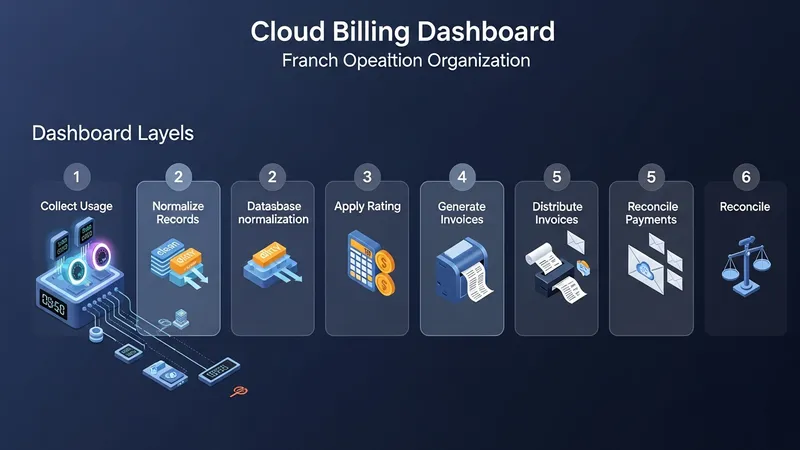
Integration with accounting and ERP systems is common in France to ensure consistency between revenue recognition and recorded invoices. Billing platforms may export journal entries or provide API connectors to local accounting suites. Reconciliation processes match bank payments — often via SEPA bank transfers — to open invoices; discrepancies trigger dispute workflows that may involve credit memos or corrective invoicing. Keeping these integrations auditable supports compliance and internal control requirements.
Capacity and scalability planning affects operational reliability. Billing systems may process large volumes of small events (e.g., object storage requests) or fewer high-value events (e.g., reserved compute contracts), and architectures often scale differently for each pattern. In France, peak usage periods driven by local business cycles can influence batching schedules and processing windows. Operational teams commonly measure processing latency, error rates in mediation, and billing run durations to plan for hardware and software capacity.
Change management and version control for billing rules and templates are operational practices that help avoid revenue leakage and customer confusion. When pricing tables or tax treatments change, organisations often maintain staged deployments and communicate expected impacts internally. In a French regulatory context, preserving historical rule versions and invoice copies supports audits and tax inspections; therefore, systems often include archival mechanisms and clearly documented change logs to record when and how billing logic evolved.