
AI-driven scheduling for plumbing businesses refers to software systems that organize appointment requests, match those requests to available technicians, and coordinate dispatch. These systems process inputs such as customer availability, technician skill sets, equipment requirements, and geographic location to produce proposed schedules. The underlying components often include calendar management, rule-based constraints, routing logic, and automation that can update assignments as conditions change, with the aim of making day-to-day allocation and dispatching more structured and data-aware.
Such scheduling platforms typically accept requests through multiple channels (phone, web form, or integrated booking widgets) and reconcile them with technician rosters, travel time estimates, and work priorities. Automation may handle routine confirmations and rescheduling, and may surface exceptions for human review when a service request requires special parts or certifications. These systems often integrate with broader field service management tools to maintain records of assignments, time on site, and completion status.
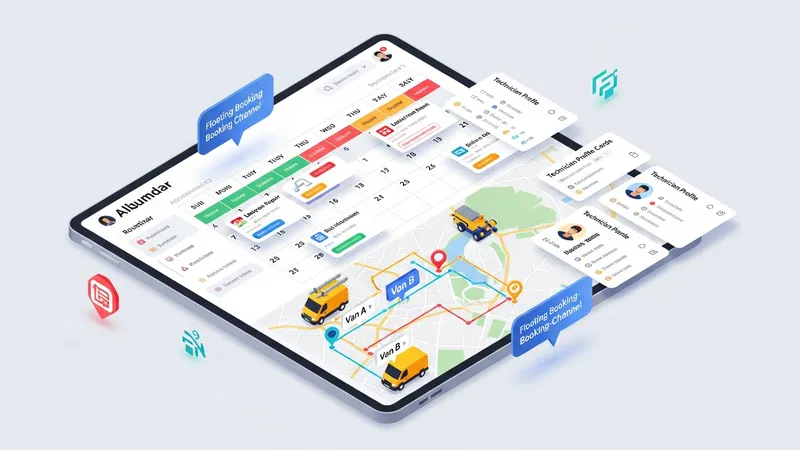
Scheduling approaches vary by complexity. Rule-based systems enforce explicit constraints such as required certifications, minimum travel times, and customer time windows; they may be simpler to configure and predictable in outcome. Machine learning methods may infer patterns in demand and technician performance to make probabilistic recommendations—these methods often require historical data and monitoring to refine their outputs. Many plumbing service operators use hybrid setups where deterministic rules handle compliance and safety constraints while lighter predictive models assist with estimating job durations or demand peaks.
Integration with dispatch workflows can change how teams respond to daily variation. When a platform integrates live location data and two-way messaging, dispatchers may reassign work dynamically to reduce idle time and balance workload. Automated notifications to customers about estimated arrival windows are a common feature that may reduce inbound confirmation calls. However, such automation typically requires careful configuration so that notifications and reassignment rules align with local labor practices and customer expectations.
Operational impacts often cited by practitioners include reduced travel time through optimized routing and improved matching of technician skill sets to task requirements, which may reduce repeat visits for follow-up work. Scheduling automation can also create more consistent utilization patterns across a fleet of technicians, though outcomes depend on data quality and how strictly the organization adheres to the platform’s suggested schedules. Planners typically treat initial estimates from automation as inputs for human oversight, especially during peak periods or for complex service requests.
Data governance and privacy are relevant considerations when automation stores customer details, location traces, and work histories. Secure handling of personally identifiable information, retention policies for location logs, and role-based access controls for dispatch data help align operations with common data-protection practices. Organizations often document which logs are retained and who may access them, and they may configure integrations to limit data sharing to necessary fields rather than full records.
In summary, AI-driven scheduling for plumbing operations encompasses appointment intake, matching logic, route planning, and dispatch coordination within integrated platforms. Systems may use rule-based logic, predictive models, or a combination to produce schedules that reflect technician qualifications, travel constraints, and customer preferences. The next sections examine practical components and considerations in more detail.
Scheduling algorithms used in plumbing service contexts typically include deterministic rule engines, constraint solvers, and predictive models that estimate task durations. Rule engines enforce explicit business constraints such as required certifications, parts availability, and mandated service windows. Constraint solvers may treat scheduling as an optimization problem that balances technician availability against required skills and customer time windows. Predictive elements can estimate how long a task may take based on historical records, which a scheduler may use to reduce overlaps or avoid excessive travel between assignments.
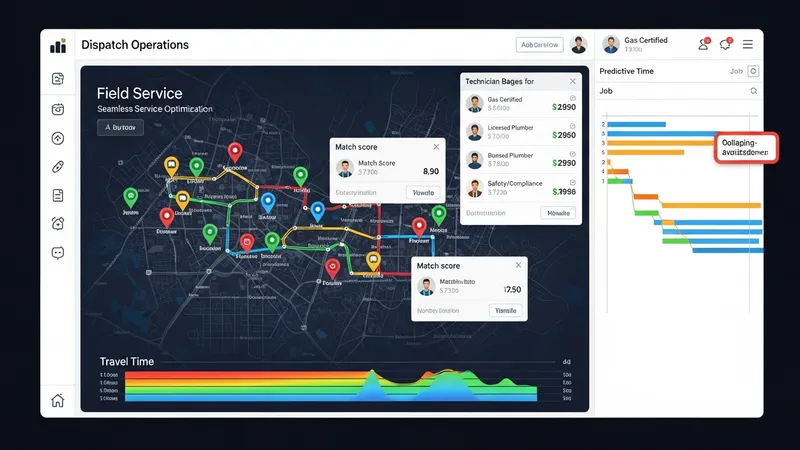
Matching logic often accounts for technician skills, licensure, tool availability, and geographic proximity. A typical approach assigns a higher match score when multiple criteria align—such as a technician already on a nearby call who has completed similar repairs previously. In practice, schedulers may apply weighted rules so that safety and compliance constraints override proximity-based preferences. Plumbers’ organizations commonly treat special assignments (e.g., gas-line work or complex diagnostic visits) as exceptions that require dispatcher approval rather than automatic assignment.
Routing and sequence optimization are core algorithmic steps once matches are suggested. Mapping and travel-time estimates use traffic models and distance matrices to sequence visits efficiently; some platforms recompute sequences in real time when a new urgent request arrives or when a technician reports delays. The trade-off between minimizing travel time and maintaining balanced workloads is often configurable, and operators typically choose settings that reflect local traffic patterns and workforce expectations.
When evaluating algorithmic approaches, it is informative to monitor schedule quality metrics such as on-time arrivals, reschedule frequency, and average travel time per technician. These metrics help calibrate rules and predictive components. Organizations often pilot new matching logic on a small subset of assignments before broad roll-out, monitoring outcomes and adjusting rule weights rather than assuming immediate improvement.
Effective scheduling systems commonly integrate with broader field service platforms that handle work orders, parts inventory, invoicing, and customer records. Integration enables a single source of truth for service history and parts usage, which in turn informs scheduling decisions—if a job requires a rare spare part, the scheduler can prevent assignments to technicians lacking that part. Two-way integrations with CRM modules allow appointment status updates to propagate to billing workflows, reducing manual reconciliation between systems.

Communication channels are central to dispatch coordination: SMS or email notifications, automated voice updates, and in-app messaging keep customers and technicians informed about timing and changes. Some setups include telephony integrations for incoming calls to create tentative appointments that feed into the scheduling workflow. Reliable synchronization between calendar systems and dispatch boards reduces double-bookings and helps maintain accurate availability windows for technicians.
APIs and webhooks facilitate real-time updates between dispatch modules and third-party tools such as mapping services or parts suppliers. For example, when a technician logs a part shortage, a webhook can notify inventory systems and adjust downstream scheduling to account for expected delays. Security and rate-limiting considerations are typical when designing integrations so that sensitive customer or location data is transmitted only as needed and with appropriate authentication.
Operational teams often document integration touchpoints and failure modes so dispatchers know fallback procedures when external services (e.g., mapping or SMS providers) are degraded. Maintaining clear logging and alerting pathways for integration failures helps keep customers informed and supports structured troubleshooting without relying solely on manual processes.
Costs for scheduling automation typically reflect licensing models, implementation effort, and any necessary hardware for technicians. Licensing may be per-user or per-technician, or it may take the form of a platform subscription, and implementation often requires data cleanup and configuration of business rules. Organizations should anticipate resources for initial setup, staff training, and periodic rule adjustments as service offerings evolve. Total cost of ownership often includes integration work, ongoing support, and occasional customization.

Adoption and change management are common operational factors: technicians and dispatchers may need training to use mobile interfaces, accept automated assignments, and report on time and materials. Usability and offline capabilities are practical considerations for areas with limited connectivity, where mobile apps that cache schedules and sync when online may be preferred. Pilot programs that incrementally introduce automation features can help teams adapt without disrupting service continuity.
Scalability and vendor support models influence long-term cost and operational resilience. Small operations may prefer simpler packages with limited integrations, while larger teams may require platforms that scale across regions and support multi-branch coordination. Maintenance agreements, update cadence, and community or vendor documentation are factors that typically inform procurement and budgeting conversations.
Security and compliance considerations may also affect operational costs. Data protection practices, access controls, and audit logging require configuration and possible legal review when customer or location data is retained. Organizations commonly balance the desire for automation with prudent data governance practices and plan for periodic reviews of permissions and retention settings.
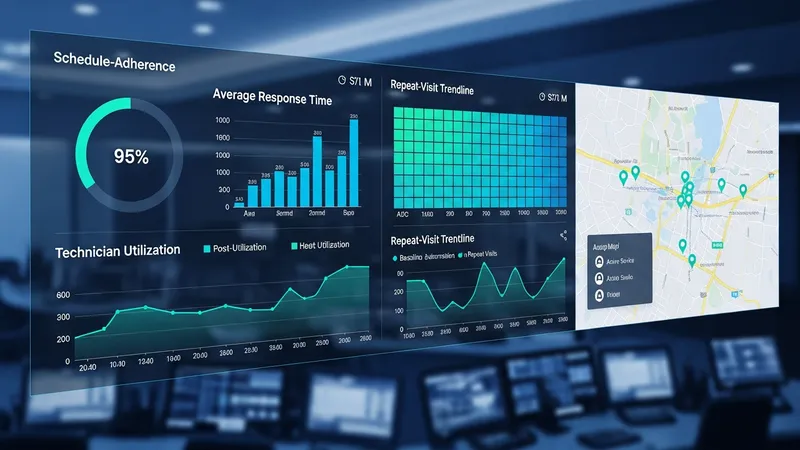
Key performance indicators for scheduling automation often include schedule adherence, average response time from request to assigned appointment, technician utilization rates, and the rate of repeat visits due to incomplete resolution. Tracking these KPIs over time helps organizations determine whether rule changes or model updates improve operational outcomes. It is typical to measure baseline performance before introducing significant automation changes to objectively assess impact.
Privacy safeguards are important when systems record customer contact details and location histories. Common practices include minimizing stored location granularity, implementing role-based access, and retaining logs for only necessary durations. Regular reviews of access privileges and data retention policies help reduce exposure and align with general data-protection expectations in many regions.
Maintenance routines for scheduling systems include updating rule sets to reflect changes in service offerings, refreshing predictive models with recent job-duration data, and monitoring integration health. Vendors and in-house teams may schedule periodic audits of routing accuracy, rule conflicts, and notification flows so that automated behaviors remain aligned with operational realities. Documentation of rule logic and change history supports informed adjustments over time.
Continuous improvement often involves controlled experiments—adjusting a single scheduling parameter or notification cadence for a subset of appointments and comparing KPI changes against a control group. Such iterative evaluation helps identify which adjustments may typically yield measurable improvements in efficiency or customer experience without assuming universal benefits across different operational contexts.