
The term "remarketing" describes a set of techniques that use audience tracking to show tailored advertising to people who have previously visited a website or interacted with a brand. In practice, remarketing relies on identifiers such as cookies, device identifiers, or hashed contact lists to re-associate users with advertising systems. The aim is informational: to reach users who have already expressed some level of interest so that subsequent messages are contextually aligned with earlier interactions. This explanation focuses on how those tracking signals are collected, stored, and matched to display or search ads within commonly used ad ecosystems.
Remarketing workflows typically involve three components: audience capture, segmentation, and ad delivery. Audience capture may occur via tag-based scripts on pages, SDK events in mobile apps, or CRM uploads; segmentation groups users by behaviour such as pages viewed or actions taken; and ad delivery maps segments to creative sets and placements. In France, operators often consider national privacy guidance and technical compatibility with major advertising platforms when designing these flows. The following examples illustrate representative tools and methods that are commonly referenced in discussions of remarketing.
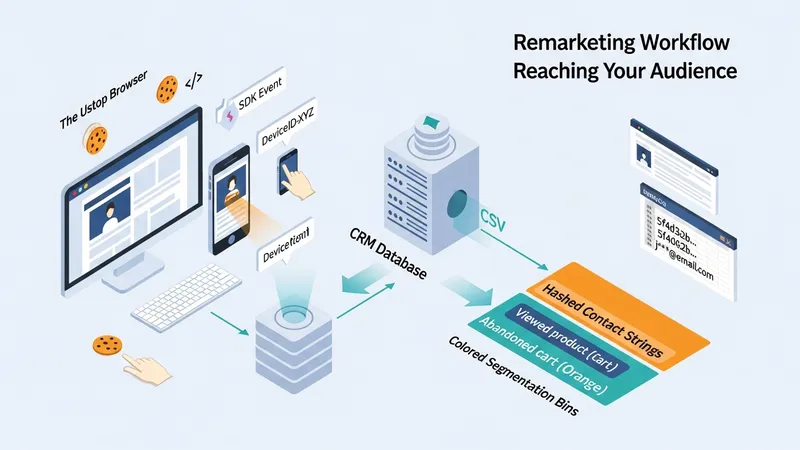
Remarketing strategies may be classified by the signal used to create the audience. For example, page-view based lists capture users who saw a specific product page; event-based lists capture users who completed certain actions like adding to cart; CRM-based lists use hashed email addresses to identify known customers. In France, platform choices and technical methods often interact with CNIL guidance and commercial relationships: some publishers integrate server-side tagging or consent management platforms to align tracking with local expectations. These design choices typically affect scale, latency, and the granularity of targeting that may be achievable.
Data governance and consent are central to remarketing in the French context. The CNIL provides recommendations on the lawful bases for processing, cookie lifetimes, and user information requirements. Practitioners in France may therefore implement explicit consent banners, store consent records, and limit retention periods to align with regulatory guidance. From a technical perspective, these compliance measures can influence which ad formats and third-party vendors are usable without additional contractual arrangements, and they can affect audience size and the continuity of campaigns over time.
From a measurement perspective, remarketing typically complements prospecting activities by focusing on higher-intent audiences. Typical evaluation metrics include click-through rate, conversion rate among remarketed visitors, and incremental lift measured via holdout groups or view-through attribution. In France, some advertisers use country-specific attribution models or partner with local measurement providers; IAB France publishes guidance on display metrics and viewability that may inform reporting choices. Measurement approaches often involve trade-offs between precision and implementational complexity.
Technical choices also shape privacy and cross-device capabilities. Cookie-based lists may work across desktop browsers but can fragment across devices; device ID approaches are common in apps but require distinct handling for iOS and Android. Server-side tagging, first-party data enrichment, or consent-aware hashing are techniques that can reduce reliance on third-party cookies and may be considered in the French market where browsers and regulation increasingly limit third-party tracking. These techniques typically require coordination between web development, legal, and vendor teams.
In summary, remarketing involves capturing user signals, segmenting audiences, and delivering subsequent ads with attention to privacy and measurement constraints. In France, operational designs frequently account for CNIL guidance, the service offerings of local vendors like Criteo, and platform-specific capabilities from Google and Meta. The next sections examine practical components and considerations in more detail.
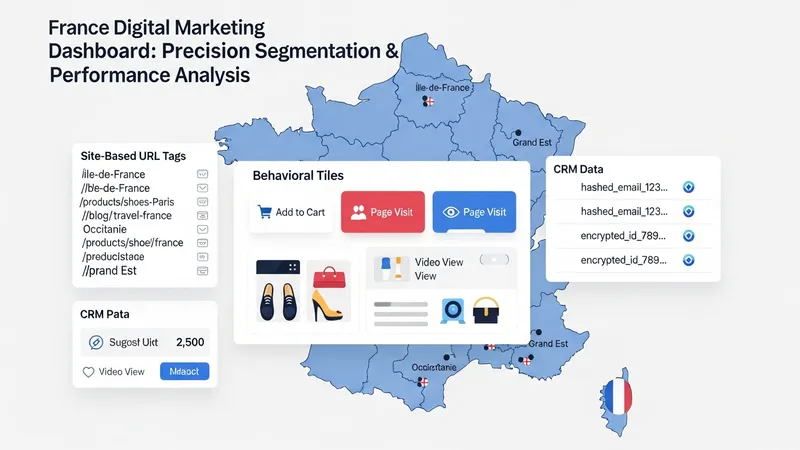
Audience definitions vary by the underlying signals used to build them. Common categories include site-based audiences (users who visited specific URLs), behavioural audiences (users who performed certain actions such as adding to cart), and CRM-based audiences (hashed email lists of known customers). In France, many advertisers segment further by language, region, or purchase intent to reflect market heterogeneity. Consideration: segmentation granularity may increase targeting relevance but can also reduce audience size, which may be especially relevant for campaigns focused on smaller French regions or niche product categories.
Dynamic product-based audiences are a subtype used by e-commerce sites: product feeds generate creative elements that match the items a user previously viewed. French retailers often pair these feeds with localised pricing and store information. Operationally, feed quality and update cadence may affect how accurately product ads reflect current availability or price in France. As a result, teams commonly treat feed maintenance and testing as ongoing tasks to keep dynamic remarketing aligned with on-site inventory.
Cross-device stitching aims to link the same user across multiple devices, typically by using login signals or probabilistic matching. In France, where single-sign-on and account-based commerce are common among major retailers, deterministic matching (via authenticated email) may be more reliable than probabilistic methods. A practical consideration is the need to document lawful bases for processing account identifiers and to ensure hashed transfers comply with CNIL and contractual vendor requirements.
Lookalike or similar audiences are sometimes derived from remarketing segments to find new prospects with comparable characteristics. French practitioners may create lookalikes from a core customer segment, but they often treat these as a separate stage from direct remarketing. When using lookalikes in France, teams typically review local data minimisation rules and monitor whether the generated audience aligns with regional market characteristics rather than assuming direct transferability from other markets.
French regulation and guidance, notably from the CNIL, shape how remarketing is implemented. Key elements include clear user information about tracking, obtaining appropriate consent for non-essential cookies, and documenting processing purposes. In practice, French websites commonly deploy consent management platforms that record granular consent choices. A relevant consideration is that absence of consent for advertising cookies typically restricts the use of third-party cookie-based lists for personalized ads in France, which can materially affect audience sizes and the feasibility of certain remarketing tactics.
Data transfers and vendor relationships are another compliance focus. When transferring hashed customer lists or device data to external platforms, French organisations often rely on data processing agreements and ensure vendors provide technical guarantees. The CNIL and European guidance emphasise purpose limitation and security measures; accordingly, operational teams may restrict retention windows for remarketing lists and implement access controls. These contractual and technical controls typically form part of vendor selection and onboarding discussions in France.
Consent lifecycles and cookie lifetimes are practical levers that influence remarketing. The CNIL has published positions on cookie lifetimes and renewal of consent; consequently, some French advertisers set conservative expiry windows for remarketing identifiers. From an operational standpoint, shorter lifetimes reduce long-term profiling risks but may decrease the available audience for remarketing, affecting how frequently campaigns need to refresh creative and revisit targeting logic.
Auditability and documentation are commonly emphasised in French compliance practice. Organisations often maintain records of processing activities, consent logs, and technical mappings between site tags and vendor platforms. These records can support internal reviews and responses to regulatory inquiries. As a consideration, investing in clear data inventories and vendor mappings may make it easier to adjust remarketing designs when regulatory guidance evolves.

Tag deployment methods include client-side tags, server-side tagging, and SDKs for mobile apps. In France, some publishers and advertisers are adopting server-side approaches to reduce client-side script load and to centralise consent enforcement. Server-side tagging can provide more control over which signals are forwarded to vendors, but it typically requires additional infrastructure and integration effort. Consideration: the trade-off between control and implementation complexity often guides whether teams pursue server-side setups in French deployments.
Consent integration is a technical priority. Consent management platforms commonly expose JavaScript APIs that gate tag firing based on user choices. French implementations frequently map CNIL-recommended categories to vendor-level permissions so that advertising tags do not fire until consent is present. Teams may also use consent logs to reconcile audience sizes reported by vendors against internal records, which can be helpful when diagnosing discrepancies in campaign reach or attribution within France.
First-party data strategies are rising in importance as browser and platform changes limit third-party cookies. Techniques used in France include strengthening first-party analytics, enhancing CRM-based matching, and using contextual signals for ad selection. For example, retailers with loyalty programs in France may prioritise consented email-based segmentation to preserve reach. These approaches typically require investment in data hygiene and secure hashing practices to ensure that uploaded lists meet platform requirements and regulatory expectations.
Testing and monitoring are practical elements of implementation. French teams often run parallel experiments to compare client-side and server-side audience counts or to validate that consent gating behaves as expected across popular French browsers. Monitoring may include periodic reconciliation of audience sizes, verification of tag firing, and checks for data leakage. Such operational checks can reduce surprises when campaigns scale or when platform policies change.

Attribution for remarketing often combines last-click, view-through, and incrementality methods. In France, marketers may reference local measurement guidelines from industry groups such as IAB France when aligning on reporting definitions. Incrementality testing—using holdout groups to measure the causal impact of remarketing—may be used to quantify effect size, though it typically requires careful experiment design and institutional support. Consideration: smaller audience sizes for specific French segments may limit the statistical power of some experiments, so teams often aggregate or extend test durations.
Reporting metrics commonly include engagement measures (clicks, CTR), conversion-related measures (conversion rate among remarketed users), and cost-efficiency indicators (cost per converted user). French advertisers sometimes integrate metrics from platform dashboards with internal sales or CRM data to produce country-level performance views. A practical point is that aligning definitions across platforms and internal systems is frequently necessary to avoid misinterpretation when teams compare remarketing performance across channels in France.
Data retention and list hygiene impact measurement quality. Regularly refreshing remarketing lists, removing stale identifiers, and documenting retention periods are practices aligned with French expectations for data minimisation. Operationally, list hygiene can affect reported conversion rates and audience overlap calculations. Teams in France may set automated processes for list expiry and provide reviewers with access to audit trails to support transparency and ongoing compliance.
Vendor selection and contractual terms carry measurement implications. When engaging platforms like Criteo or broader ad networks, French organisations often review data processing agreements for reporting access, data portability, and allowed uses. Measurement capabilities (raw event exports versus aggregated dashboards) vary by vendor and can influence what kinds of analyses are feasible. As a consideration, clarifying reporting needs early in procurement and ensuring contractual alignment with French data guidance can reduce integration friction and support more reliable remarketing measurement.